

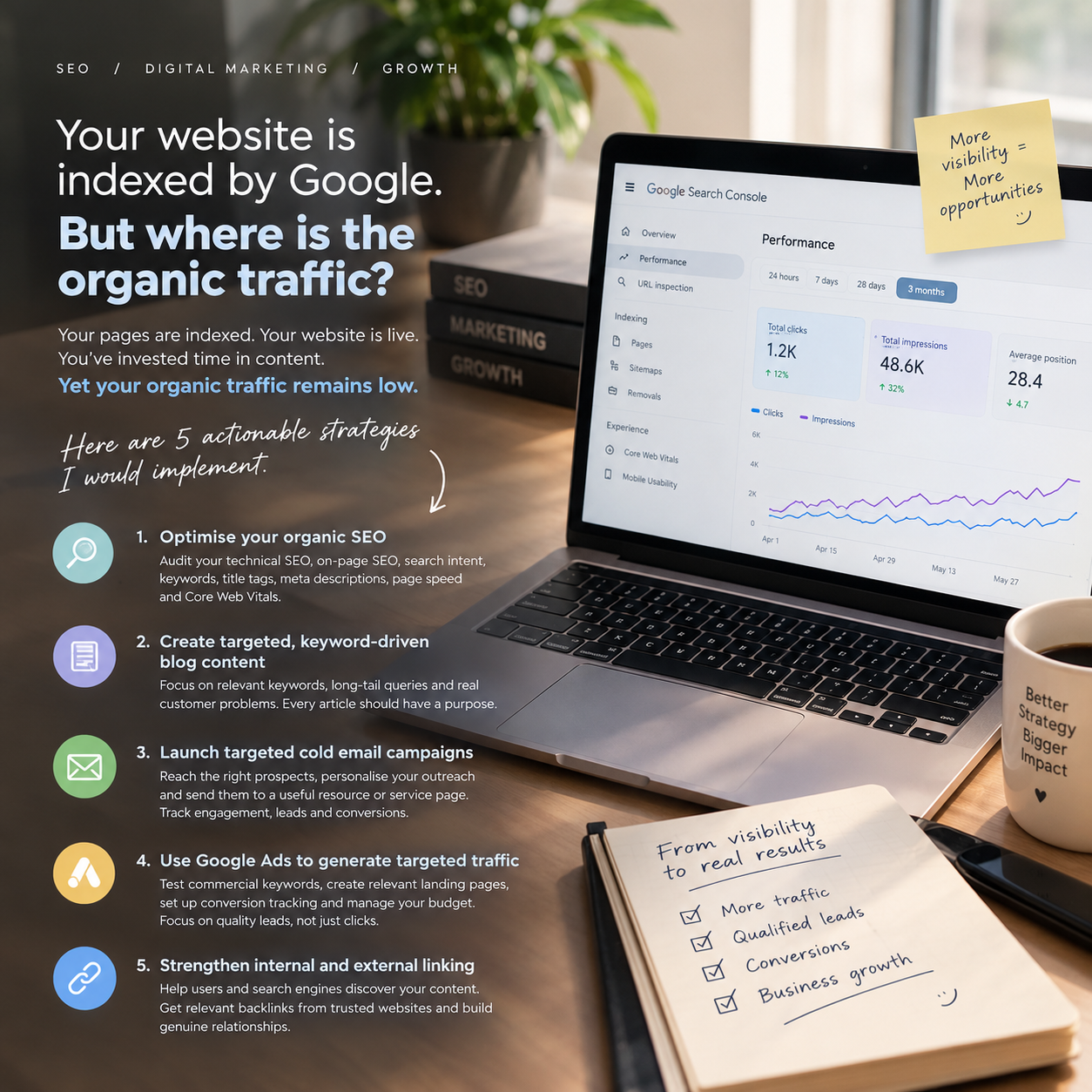
Your website is indexed by Google, but you’re still struggling to attract visitors? Your pages appear in Google’s index, yet organic traffic remains low and your content generates few leads or conversions.
Being indexed does not guarantee high rankings, organic visibility, or website traffic. To improve your results, you need a targeted SEO strategy that combines technical optimisation, keyword-driven content, outreach, paid advertising, and strategic link building.
Here are five actionable strategies to help you turn search visibility into measurable business growth.
1. Optimise Your Website for Organic SEO
Start by reviewing your website’s technical SEO and on-page SEO. Even indexed pages may struggle to rank if they target the wrong keywords, provide a poor user experience, or fail to satisfy search intent.
Focus on:
- Keyword research: Identify relevant keywords based on search volume, competition, search intent, and business value.
- On-page SEO: Optimise title tags, meta descriptions, H1/H2 headings, image alt text, and URL structure.
- Technical SEO: Check crawlability, indexability, XML sitemaps, canonical tags, broken links, and duplicate content.
- Website performance: Review mobile usability, page speed, and Core Web Vitals.
- Content quality: Make sure every page provides useful, original information that addresses the visitor’s needs.
Use Google Search Console to identify pages receiving impressions but few clicks, queries where your pages rank poorly, and opportunities to improve existing content.
The objective is not simply to optimise more pages. It is to improve the relevance, usability, and search performance of the pages that matter most to your business.
2. Create Targeted, Keyword-Driven Blog Content
Publishing blog posts without a clear keyword strategy can generate content without attracting qualified visitors.
Build a content marketing strategy around the questions, problems, and needs of your target audience.
How to build an effective SEO content strategy
- Conduct keyword research to identify relevant search terms and long-tail keywords.
- Analyse search intent to understand whether users want information, comparisons, or a product or service.
- Create helpful blog articles that answer specific questions.
- Organise related articles into topic clusters around your main services or areas of expertise.
- Refresh existing content when information becomes outdated or search intent changes.
For example, instead of targeting a broad keyword such as digital marketing, a business could create focused content around how to improve organic traffic for a small business website.
Targeted content helps you reach people who are actively looking for answers and creates opportunities to guide them towards relevant services or products.
3. Use Targeted Cold Email Outreach to Generate Traffic and Leads
Organic SEO takes time. While improving your search visibility, targeted cold email outreach can help you connect directly with potential customers, partners, publishers, and relevant businesses.
The key is to prioritise relevance over volume.
A practical outreach process
- Define your ideal customer profile and identify relevant prospects.
- Personalise your emails around a specific need or business opportunity.
- Share a useful resource, case study, service page, or relevant offer.
- Use a clear call to action that gives recipients a reason to visit your website.
- Track qualified responses, website visits where measurable, leads, and conversions.
Cold email is not a direct Google ranking factor. Its value lies in generating business opportunities and building relevant relationships that may lead to referrals, collaborations, or editorial links.
Follow applicable privacy, data protection, and email marketing regulations, and avoid indiscriminate mass emailing.
4. Launch Targeted Google Ads Campaigns
When you need to attract potential customers while your organic rankings develop, Google Ads can complement your SEO strategy.
Paid search advertising allows you to target relevant queries and test which commercial keywords attract qualified visitors.
To get started:
- Select keywords aligned with your products or services.
- Group related keywords into focused ad groups.
- Write relevant ad copy that matches the searcher’s intent.
- Direct visitors to dedicated landing pages rather than generic pages.
- Configure conversion tracking and establish a controlled advertising budget.
- Monitor cost per lead, conversion rate, and return on ad spend.
Google Ads can generate paid traffic, but it does not automatically improve organic rankings.
Use campaign data to understand customer demand, test offers, and identify opportunities for your wider digital marketing strategy.
5. Strengthen Internal Linking and External Link Building
A well-planned linking strategy helps visitors navigate your website and helps search engines discover relationships between your pages.
Internal linking
Internal links connect relevant pages within your own website.
To improve your internal linking strategy:
- Link from high-value pages to relevant service pages and blog articles.
- Use descriptive anchor text that explains what the linked page offers.
- Connect related articles into logical topic clusters.
- Make important pages easy to discover without excessive clicks.
- Review broken links and avoid unnecessary redirects.
External linking and backlink acquisition
External backlinks are links from other websites pointing to yours. Relevant, trustworthy backlinks can support discovery and contribute to your website’s authority and ranking potential.
Focus on sustainable link-building methods, including:
- Creating original resources that other websites may reference.
- Developing genuine partnerships with relevant organisations.
- Contributing expert insights to reputable industry publications.
- Earning links through useful research, case studies, and high-quality content.
Avoid buying manipulative links, automated link schemes, and irrelevant mass submissions. Prioritise editorial relevance and the genuine value a link provides.
How to Measure SEO Performance
An effective SEO strategy must be measured consistently. Track both visibility and business outcomes to understand which actions are producing results.
| Metric | What it helps you understand |
|---|---|
| Google Search Console impressions | How often your pages appear in Google Search |
| Organic clicks | How many visits come from Google Search results |
| Click-through rate (CTR) | How often impressions lead to clicks |
| Average search position | Where your pages generally appear for tracked queries |
| Organic sessions | How much traffic arrives through organic search |
| Conversion rate | How effectively visitors complete desired actions |
| Qualified leads | Whether your traffic attracts potential customers |
| Cost per lead | How efficiently paid campaigns generate leads |
Compare performance over consistent periods and segment results by page, query, device, and country when relevant.
Do not focus on rankings alone. The real objective is to attract relevant visitors, generate qualified leads, and improve business results.
Final Thoughts: Turn Search Visibility into Business Growth
If your website is indexed by Google but receives little organic traffic, publishing more content is not necessarily the answer.
Start with a clear diagnosis. Improve your organic SEO, create targeted blog content, use personalised outreach, test Google Ads where appropriate, and strengthen your internal linking and backlink profile.
Then measure the impact and prioritise the actions that deliver meaningful results.
The principle is simple: diagnose first, optimise strategically, and measure continuously.
A website does not need more activity for the sake of activity. It needs a clear strategy that connects search intent, useful content, relevant traffic, and conversions.